



How to choose your solid soap?
Written on March 4, 2020 by Anne-Marie — Updated on September 30, 2021
Have you ditched the bottles on your bathtub in favor of solid soap, which has been touted as more eco-friendly, healthier, and better for your skin? Great idea! All of this is very true... provided you choose the right one. And that's not so easy: with the welcome development of Zero Waste, the worst rubs shoulders with the best. Follow the guide!
Is solid soap necessarily better?
Long considered old-fashioned, bar soap has made a big comeback. And that's a good thing! For the planet, for starters. Because liquid soap means bottles. Usually plastic, potentially recyclable but rarely recycled... In contrast, solid soap can mean zero packaging, 25% less CO2 over its entire life cycle, and a guarantee against overconsumption: for hands alone, we use six times less than with a liquid product. Obviously, this has an impact on our wallets: even high-end soap ends up being three times cheaper.
Another major advantage of solid soap is that it does not require preservatives. It's impossible to ignore shower gels, which contain a lot of water. And while parabens have fortunately become rare, their most common replacements, methylchloroisothiazolinone and methylisothiazolinone, are just as dangerous. In fact, they are banned in leave-on products... Let's add a few fabulous innovations such as exfoliating shower gels and their microplastic beads, which are disastrous for aquatic environments. In short, not great.
But for the rest, if they are conventional, soap or shower gel, it's all the same. What's wrong with them? Not their effectiveness: when it comes to cleaning, they clean. But at what cost! The fault lies with their sulfated, petrochemical, and highly polluting surfactants. In particular, Sodium Lauryl Sulfate (SLS) and Sodium Laureth Sulfate (SLES): inexpensive and super foaming, they show no mercy to impurities... or to the oils in our hydrolipidic film. If they can degrease an engine, you can be sure that your sebum won't stand a chance. Your skin may be clean, but it will be irritated, weakened and exposed to other dangerous substances... which they don't skimp on: EDTA color and texture stabilizer, endocrine disruptors in BHT antioxidant and allergenic synthetic fragrances, controversial dyes such as titanium dioxide... Lots of lather, exotic colors, original fragrances? Be wary!
An organic label will protect you from certain substances, but not all of them : ammonium lauryl sulfate, for example, a naturally-derived but irritating surfactant, is authorized by Ecocert and Cosmebio. To give your skin the best, you need to look further.
Good fat makes good soap
The chemical reaction that produces soap, saponification, was developed centuries ago. What does it require? Triglycerides from a fatty substance and an alkaline agent. On the alkaline side, there are few questions to ask: soda for solid soap, potash for soft soap. On the fatty side, there are more choices since, in theory, all fatty substances can be saponified... with results that are more or less desirable.
Animal fats, tallow, or lard have been used since ancient times. However, they have little to recommend them: obtained by melting animal fat, they produce soaps that quickly become rancid, are uninteresting, and can even irritate the skin. Nevertheless, manufacturers still use them extensively. That's right, there is no cheaper way to produce soap... Beware of supermarket soaps and fake artisanal products sold at markets or souvenir shops: Sodium Tallowate ? Beef fat. Sodium Lardate ? Pork. As for donkey's milk and goat's milk, it's different: they are not used in the saponification process, are added afterwards, and their benefits are real. But at oOlution, we have made an ethical choice: not to participate in any form of animal exploitation.
Especially since vegetable fats knock them out. Their fatty acids, which have a strong affinity with our skin, result in a healthy and effective soap. And they have a big plus: their unsaponifiable fraction unsaponifiable fraction. Their vitamins E and A, squalene, phytosterols, and terpenes do not react with soda but remain intact. The soap thus inherits their precious properties: antioxidant, protective, restructuring, nourishing, softening... With the huge variety of vegetable oils available, it's easy to meet all your skin's needs! Just avoid the disastrous palm oil, which is common even in so-called traditional soaps. Once saponified, it appears as Sodium Palmate or Sodium Palm Kernelate.
Instead, look for shea butter, sodium shea butterate, which is exceptionally rich in unsaponifiables, for a creamy and nourishing solid soap.Olive, sodium olivate, with its precious unsaponifiables, gently cleanses.Coconut oil, sodium cocoate, with its strong cleansing power, gives a pleasant lather and a firm texture to solid soap. All of these ingredients are used in the composition of our Soap Rise. As you can see, chemical additives and surfactants are really unnecessary!
A mild soap: a question of glycerin and temperature
However, even soap made from the finest vegetable oils has one drawback : it is an alkaline surfactant. It inevitably strips our skin , which has a slightly acidic pH. But that's exactly what we want it to do to rid the skin of impurities and excess sebum.
This is where the second substance produced by saponification comes in: glycerin. It does not cleanse, but its role is just as essential. Emollient, moisturizing, and capable of attracting water, it leaves a protective film that compensates for the action of the soap by restoring the hydrolipidic film almost immediately. Without it, your skin would feel terribly tight! The manufacturing process of your soap determines the quantity and quality of its glycerin.
On the industrial side, it's a disaster! To speed up saponification and improve profitability, manufacturers heat a mixture with a high soda content to very high temperatures. As a result, the heat degrades the fatty acids, destroys the unsaponifiables, and several rinses are necessary to remove the excess soda. These rinses also extract glycerin (which is then sold separately because it is much more profitable...). A few undesirable additives and a little petrochemical glycerin are then added to cover up the flaws. The result is a harsh, drying, and polluting product that has long given soap a bad image.
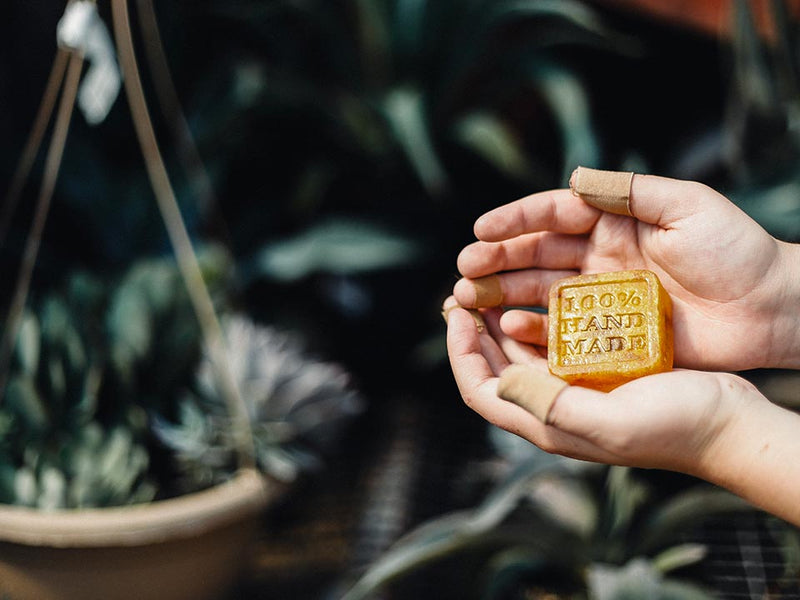
With cold-processed handmade bar soap, the reaction is slow, at room temperature or below, and continues for at least four weeks of drying. This is necessary to preserve the fatty acids, unsaponifiables, and, of course, all the glycerin. Of course, the family of natural, handmade, plant-based solid soaps also includes a hot-processed clan: the famous solid soaps from Marseille and Aleppo. Heated slowly with a much richer oil composition than industrial solid soaps, they are nevertheless less rich in glycerin than cold-saponified soaps. And less rich overall: a cold-process soap can draw on the immense variety of vegetable oils, while hot-process soaps can only use those that are heat-resistant. And Ultimately, without AOC certification or a patent, their market is largely flooded with fake industrial products made from palm oil, synthetic fragrances, and dyes. With cold-process soap, this is impossible: the process cannot be industrialized.
Would you like some more fat?
In short, for dry and sensitive skin, babies, and children: cold-processed solid soaps are a must. And highly recommended for everyone else. Even more so when they are superfatted. Yes, we want more fat!
Saponification is a complete chemical reaction total : it only stops when one component is exhausted. By adjusting the proportions, it is possible to ensure that not all of the oil is transformed into soap at the end of the process. You can also add unsaponified oils towards the end of the preparation. The advantage? An even gentler, more nourishing bar soap that becomes a real skincare product! To ensure that your solid soap is truly superfatted, check its composition: in addition to saponified oils or butter (INCI name with sodium +ending in -ate), others are listed under their usual name (Latin name of the plant + oil).
The possibilities are as numerous as the vegetable oils themselves, allowing you to meet the needs of all skin types and conditions. The best approach? Take advantage of synergies with a solid soap rich in high-quality vegetable oils and butters. This is the profile of our Soap Rise, composed of 24 organic cold-pressed vegetable oils and an oily macerate : shea butter, softening and nourishing olive and sweet almond oils, soothing and anti-dehydrating coconut oil, anti-dryness macadamia and avocado oils, antioxidant and revitalizing borage, rosehip and evening primrose oils, and repairing hemp oil... Of course, it contains no palm oil and is traditionally handmade in the Hautes-Alpes region of France. Sensitive skin, children, pregnancy, or breastfeeding: our organic, fragrance-free Soap Rise is suitable for everyone. For others, there is a version scented with essential oils of citrus, frankincense, ylang-ylang, and orange blossom for a subtle, relaxing, and energizing balance. Want a pleasurable shower without synthetic fragrances? This is for you!
Used every day, all over our skin, and discharged directly into our waterways: the choice of our bar soap is far from insignificant. Yes, our daily shower is not just a matter of hygiene. With a superfatted , cold-processed, superfatted bar soap, it even becomes an essential health and beauty ritual and a militant act for the planet!

Recommended products
You may also like

natural ingredients VS synthetic ingredients
Zero waste cosmetics: for an ecological beauty routine

Paraben, phenoxyethanol...: the 6 dangerous cosmetic preservatives to avoid


